Names First, Paint Second: Fifty Paint-Chip Landscapes and the Absurd Labels That Picked My Palettes
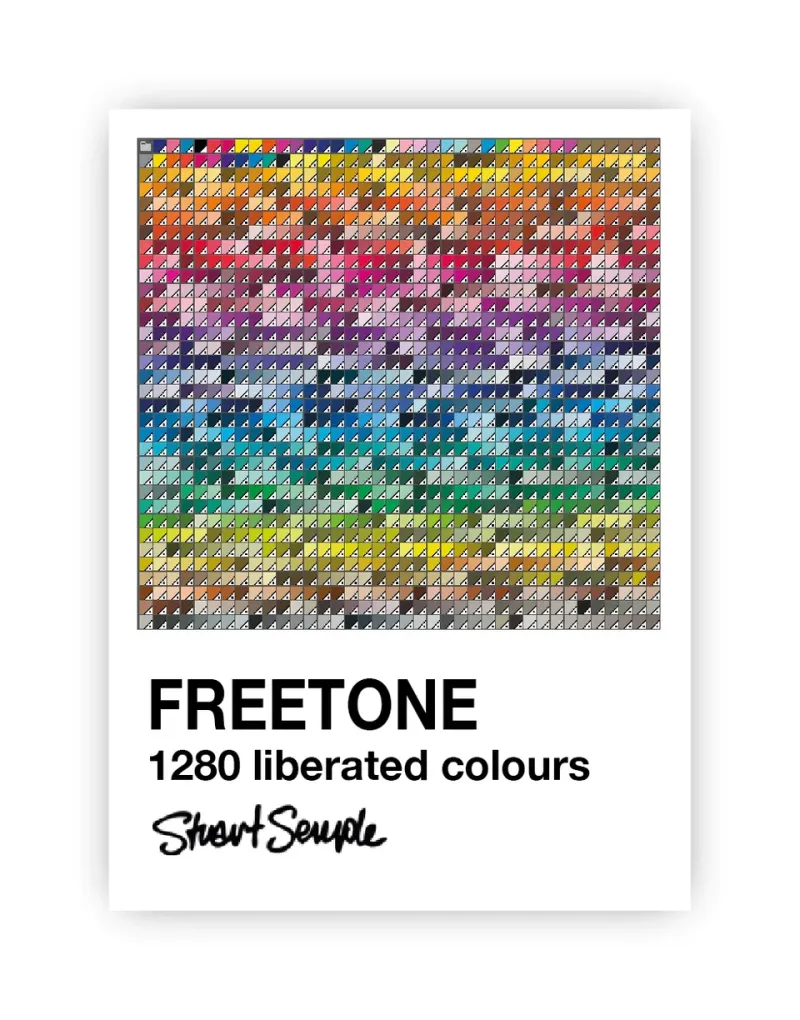
Photo: Stuart Semple, Public domain, via Wikimedia Commons
The paint chip rack at the hardware store is free, which is exactly the kind of price my art practice respects. So this fall I walked in with a tote bag, walked out with a fistful of swatches, and spent a handful of weekends turning fifty of them into tiny landscapes. Not one is bigger than a business card. Not one cost me a cent in surface material. And not one let me cheat on color.
The Rules, and the One I Broke by Tuesday
I set five rules before the first brush touched paper:
- One chip, one landscape.
- Use only the colors printed on that chip. No outside paint. A black and white gel pen was allowed for marks and tiny details.
- No cropping the chip to hide a stripe I did not like. If the card had a band of Toasted Marshmallow along the bottom, the sky had to deal with it.
- Finish in one sitting, roughly twenty to forty minutes.
- Write the color names and the date on the back before painting, not after.
By Tuesday I had broken rule two exactly once, and I am not sorry. I allowed myself a single extra color per chip, but only if the name was too good to ignore. That is how a quiet little seascape ended up with a stripe of Cracked Pepper in the foreground. It looked like driftwood. It looked better.
The Names Did the Choosing
Hardware store color names are a genre of American poetry written by committee. They are also, if you let them, a set of instructions.
I would plan a mountain and then read Swiss Coffee on the card and switch to a dairy barn. I would sketch a desert and then see Reflecting Pool and suddenly there was water. Sea Salt made me paint fog. Gobi Desert made me paint a road trip. Whipped Strawberry turned into a sunset over a strip mall, which is a sentence I did not expect to write this year.
A few favorites from the rack:
- Swiss Coffee: a warm beige that reads like a tiny vacation.
- Elephant's Breath: a real name, a warm gray, and the perfect November sky.
- Ballerina Gown: pale pink, used almost entirely for cloud bellies.
- Malted Milk: a cream that ended up in more than one diner scene.
- Cracked Pepper: near black, deployed for birds, fences, and one very dramatic tree.
- Oyster Catch: a gray with a green lean that made me paint a harbor I have never visited.
The names changed my choices more than any color theory book has. When a swatch is labeled Oyster Catch, you do not paint a parking lot. You paint a boat.
What Fifty Tiny Skies Taught Me About Restraint
Limits are the whole trick. When a card gives you four colors, you stop shopping and start solving. Value does the heavy lifting. I learned to repeat one color in three places so the composition would hold together — a stripe of sky, a stripe of water, a stripe of roof. I learned to let temperature win: if the chip leaned warm, I leaned into it instead of fighting it with a cool blue I did not have.
The chips also killed my habit of adding one more thing. On a two-by-four-inch surface, there is no room for one more thing. There is barely room for the thing you already planned. That constraint followed me back to my regular illustrations, where I now ask a simpler question before adding a color: is this on the card, or am I just bored?
And here is the free part: the rack is a color theory class you can take standing up. You can hold two chips side by side and see in ten seconds why one pairing sings and the other one sulks. No subscription, no swatch book, no shipping.
Steal This for a Weekend
This is a genuinely good weekend challenge, and it costs almost nothing.
Go to a US hardware store — Home Depot, Lowe's, Ace, or your neighborhood paint counter. Ask first if you are taking a stack; most stores are fine with a handful for an art project and less fine with a shopping bag. Take twelve to fifteen chips. Pick one. Set a timer for twenty-five minutes. Paint the landscape the names suggest. Write the date and the color names on the back. Repeat until the weekend is over.
Materials that work: cheap watercolor or gouache, a brush you do not love, a black gel pen, a white gel pen, and a glue stick if you want to mount the finished chips in a notebook. That is it.
A few prompts to get moving:
- One chip, one horizon.
- Paint the landscape the names suggest.
- No black unless the chip has a black.
- Same scene, three different chips, three different moods.
The Rack Is Still Free
Fifty landscapes later, the takeaway is not the pile. It is that the palette was never the problem. My favorite is a two-by-three-inch beach painted entirely in Swiss Coffee, Sea Salt, and Cracked Pepper. It looks like a foggy morning on the Oregon coast. It cost me a walk down the paint aisle and about thirty minutes.
If you try this, send me the weirdest color name you find. I am still looking for one that beats Elephant's Breath, and I am prepared to lose.