My New Art Director Has No Arms, No Opinions, and a $7 Price Tag
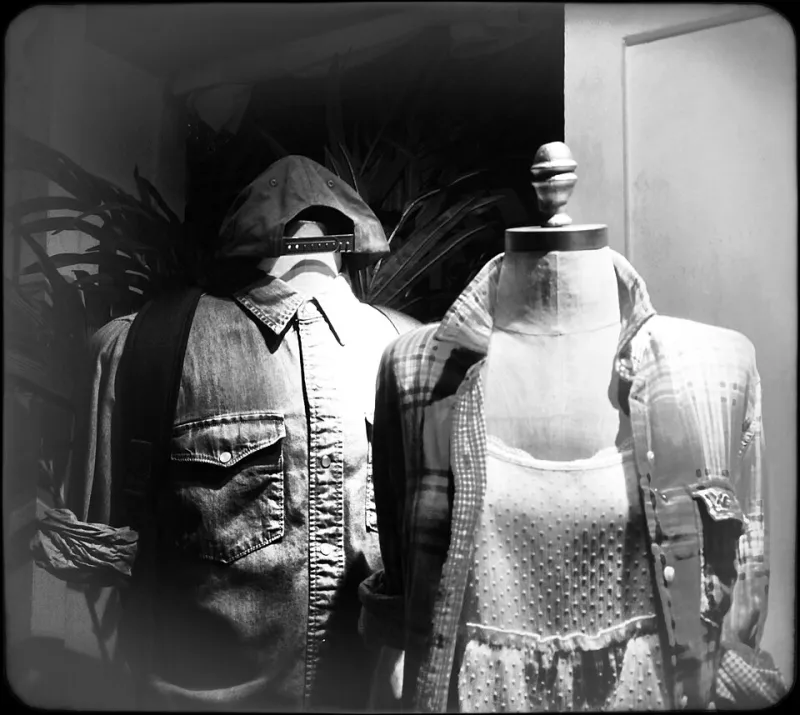
Photo: Michael Scialdone, CC BY 2.0, via Wikimedia Commons
The mannequin was seven dollars and missing an arm. The thrift store had priced it as a problem rather than a torso, which is exactly how I knew we would get along.
Her torso is a slightly wrong flesh tone — the beige of a bandage, maybe — and she has a crack down one hip that someone has clearly tried to fix with hot glue. She does not have a name. Over the course of November, everyone else gave her one, and none of them stuck, because I kept calling her the boss.
Why Give a Plastic Dummy That Kind of Power
Here is the problem I was actually trying to solve. I make small illustrations one at a time, and I make them slowly, because I spend the first hour of every one of them making color decisions that do not matter. Do I want this warm? Cool? Blue or red? I circle the same four options until I get bored and pick the safe one. The safe one is always the same painting I have already made.
What I needed was a decision-maker I could not argue with.
A plastic mannequin is the perfect boss. She has no feelings. She does not sit in a meeting and say she trusts my instincts. She does not care if I am behind schedule or if the client wants something more corporate. She just stands there wearing whatever I put on her, and the outfit is the palette. That is the whole system.
The Rules, Printed and Taped to the Wall
- Every Monday, the boss gets a new outfit, sourced from the deepest, most questionable layer of my own wardrobe.
- From that outfit I pull exactly five colors. Three main, two accent. No substitutions after Monday.
- Every painting that week uses the five colors. No white unless white was in the outfit. No black unless the outfit had black.
- No new supply shopping. The entire point is that the constraint does the work.
That was it. Four rules, thirty-one days, and a torso in the corner of the studio.
Week One: The Seniors' Pancake Breakfast Shirt
Week one she wore a shirt I have kept for fifteen years for no defensible reason: a tropical print from a seniors' pancake breakfast benefit, teal ground, hot pink orchids, yellow lightning somewhere in there. It is a terrible shirt. Every painting that came out of it was excellent.
Five colors: teal, hot pink, yolk yellow, cream, deep maroon. I made seven small still lifes and two portraits of strangers I invented, and I made them in about half the usual time, because there was nothing left to decide. The palette was in the room. I just had to keep up.
Week Two: The Safety Vest
Week two I put a borrowed safety vest on her over a black turtleneck. This was the wrong call and the best lesson.
Neon orange and black is a palette with no mercy. It punishes you if your values are sloppy, which mine were. I painted three absolutely ugly things by Wednesday — collapsing shapes, muddy mid-tones, a figure that looked like a bar of soap — and then on Thursday I stopped trying to add colors and just painted a flat black parking cone on a flat orange ground, and it was the best painting of the week.
That was the day I learned the difference between a hard palette and a bad one. The palette was fine. I was the problem.
Week Three: St. Patrick's Day, in the Wrong Month
She wore a bright green sweater vest in mid-November, purely because I found it in a bag of things I meant to donate in 2021.
Green vest, orange scarf, navy skirt, tan shoes, white collar. The green-orange pairing is the most abused combination in America, one week every March, and I made it strange on purpose: forest green and pumpkin and a hot navy, no red anywhere. I painted thirty tiny bits of a fake town — a bench, a hydrant, a croissant, a cat — all in the same five colors. That week I felt like a machine that had finally been switched on.
Week Four: The Full Disaster
Week four she wore everything: a floral dress over a striped turtleneck, a red belt, green tights, one yellow shoe and one orange boot.
This was supposed to be a joke week and instead it taught me the most. Seven colors is too many for a five-color rule, so I cut it down to the ones that were actually shouting — red, green, yellow, orange, plus the floral dress's blue as a wildcard. The paintings came out loud and a little unhinged and one of them, a chef holding a giant spoon, is my favorite thing I have painted since early summer.
The Reactions, Which Were Mostly About the Customers
I did not expect this part. The boss stands in the front room of the studio, which is technically a shop, and customers have opinions.
A little kid asked if she was a robot and then informed me she was not scary, which I found both reassuring and slightly hurtful. A man in his sixties looked at her for a long time and asked whether I dressed her every day, and when I said yes, he said that was the most commitment he had seen from an artist and told me about a neighbor of his who painted the same barn for nine years. Two separate people tried to buy her.
By the end of the month, one regular had started checking the outfit before looking at the paintings, which is, honestly, a completely valid way to view art.
What a Plastic Boss Actually Taught Me
The lesson is not about color. It is about speed and permission.
Every artist I know has a version of the same problem: we treat taste as something to be consulted, when really taste mostly needs a boss to overrule it. The mannequin did that. She had no interest in my preferences. She just wore the shirt, and the shirt had already decided.
Thirty-one paintings in a month is more than double my usual output. Not because I got faster at painting. Because I stopped spending an hour in the middle of a decision that was never going to matter.
She is back in the corner now with a scarf on. I am taking a week off. I suspect she does not care, and I find that extremely motivating.