No Undo, No Prompt, No Problem: Thirty-One Days of Drawing Whatever Was Already on My Block
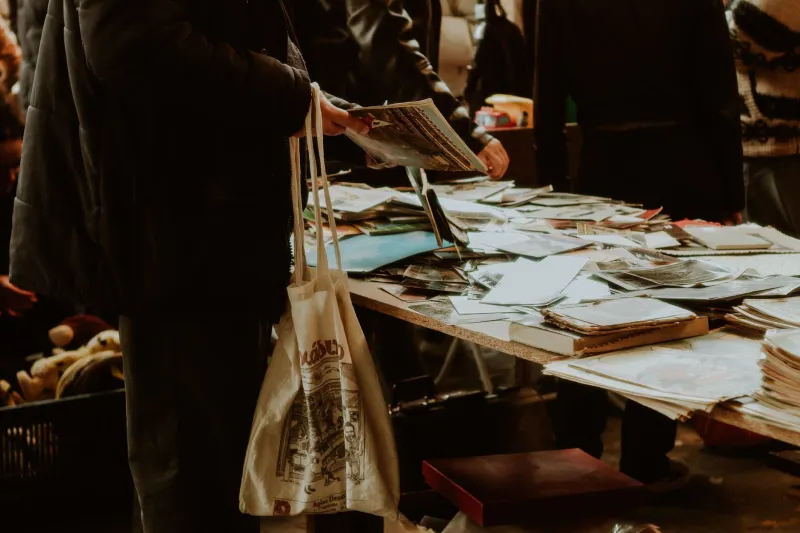
Photo: Francesco Lorenzi, CC0, via Wikimedia Commons
On the first morning of October, I sat on my front steps with a sketchbook and stared at a leaf stuck to the curb. Not a beautiful leaf. A brown, rained-on, half-flattened leaf with a gum wrapper fused to one corner. I drew it in pen, badly, and then I did the same kind of thing thirty more times.
That was the whole challenge: one hyper-specific, aggressively mundane scene from my own block every day for a month. No image search. No generative fill. No Ctrl+Z, because I was working in ink. And after each sketch, I gave the subject a score on a completely made-up scale I called Prompt Impossibility—basically, how hard would it be to get a machine to produce this exact thing if you only had words?
This is not a science experiment. It is a sketchbook report from an independent artist who got tired of looking at the same five hundred polished images every time I opened my laptop.
The rules, and the one I broke immediately
The rules were simple. The subject had to be within two blocks of my apartment. It had to be something I could see with my own eyes that day, not something I remembered. Twenty minutes max per page. Pen only. No cropping the weird parts out.
I broke the twenty-minute rule on day four, when I got stuck on the way a plastic bag had wrapped itself around a chain-link fence. It was too good. The bag had a hole in it shaped like Ohio. I spent forty minutes and I regret nothing.
Week one: the stuff you stop seeing
Day one was the leaf. Day two was the rubber band the mail carrier drops on the sidewalk every single day, which has somehow become a permanent landmark. Day three was a chipped curb with a dandelion growing out of the crack, and day four was the bag-fence situation.
By day five I noticed something embarrassing: I had been walking past all of this for years and could not have described any of it from memory. My brain had been filing it under "background." The challenge forced me to promote the background to the main event.
My Prompt Impossibility scores for that week were mostly threes and fours. A fire hydrant? Easy to prompt. A fire hydrant with a faded sticker for a plumbing company that closed in 2009, a small dent on the left side, and a twist of dry grass caught behind the cap? Much harder. The score went up. The drawing got better. That was the pattern all month.
Week two: weather, neighbors, and one extremely slow truck
Then the weather turned. I drew rain hitting a storm drain at an angle, which is mostly a study in gray scribbles and regret. I drew the exact way my neighbor's screen door hangs crooked, with a bungee cord doing structural work it was never designed for.
One afternoon a delivery truck parked across the street and idled for so long that I drew the driver's arm resting on the window frame, a coffee cup balanced on the mirror, and the specific sag of the truck's rear suspension. That one got a nine on the Prompt Impossibility scale. You can ask for "a delivery truck on a residential street." Good luck asking for that sag.
My favorite sketch of the week was a small one: a dog waiting outside a corner store, tied to a parking meter with a leash that was one link too short, so the dog had to stand at a slight diagonal. I drew the diagonal. I drew the dog's patient little eyebrows. I did not draw a heroic sunset behind it, because there wasn't one. There was a parking sign and somebody's recycling bin. It was perfect.
Week three: the scale gets weird
The Prompt Impossibility scale started to fall apart around week three, in the best way. I realized the hardest things to prompt were not complicated scenes. They were scenes with one wrong detail that made the whole thing true.
A stack of free newspapers on a corner, with the top one swollen from rain and the bottom one still dry. A hand-painted sign taped inside a laundromat window, with the letters getting smaller as the sentence went on because the owner ran out of room. A single sneaker on top of a bus shelter, and no other explanation. That sneaker got a ten. I still think about the sneaker.
Meanwhile, the things I assumed would be hard—a crowded sidewalk, a row of brownstones—were actually easy to approximate and weirdly boring to draw. Specificity was doing all the work. Not detail for its own sake. Specificity with a reason: the crooked bungee cord, the too-short leash, the sign that ran out of room.
What actually improved
I am not going to pretend a month of curb drawings turned me into a different artist. But three things changed.
First, my observation got faster. I could find the one interesting thing in a dull scene in about ten seconds by the end of the month, which is a useful skill when you are sketching on a lunch break.
Second, my line got more decisive. Ink does that. When you cannot erase, you stop negotiating with every mark and start committing. Some of those committed marks are terrible. A few are the best lines I have drawn all year.
Third, I stopped waiting for a good subject. The good subject is usually already there, sitting on the curb, looking like a gum wrapper.
The uncomfortable part: specificity is a skill, not a flex
Here is my opinionated take, and you can take it or leave it. The art world is currently very impressed with speed. Type a sentence, get an image. Great. But the images that stick with me—mine, yours, the ones in the museum—are almost never the ones that could have been described in a sentence.
They are the ones with the bungee cord. The sag. The dog standing at a diagonal. The stuff that came from somebody actually standing on a sidewalk in the cold, paying attention to a block they have walked down a thousand times.
That is not an anti-tool rant. I use digital tools every day; I love a good layer stack. But a prompt is a summary, and a sketchbook is a record. One compresses the world. The other notices it. For thirty-one days I chose noticing, and the sketchbook got messier, weirder, and a lot more like the actual street I live on.
What I am keeping
I am keeping the scale, mostly because it makes me laugh. I am keeping the twenty-minute limit, because deadlines are a kindness. And I am keeping the habit of drawing one unremarkable thing before I start the "real" work of the day. It warms up my hand and my attention at the same time.
If you want to try it, start tomorrow. Do not wait for a good view. Walk to the end of your block, find the least impressive object you can see, and draw it in pen. Then give it a Prompt Impossibility score and a one-sentence defense. Post it if you want. I will be over here, still thinking about that sneaker.