Return to Sender? Never: Thirty Palm-Sized Storefronts and the Shops That Wrote Back
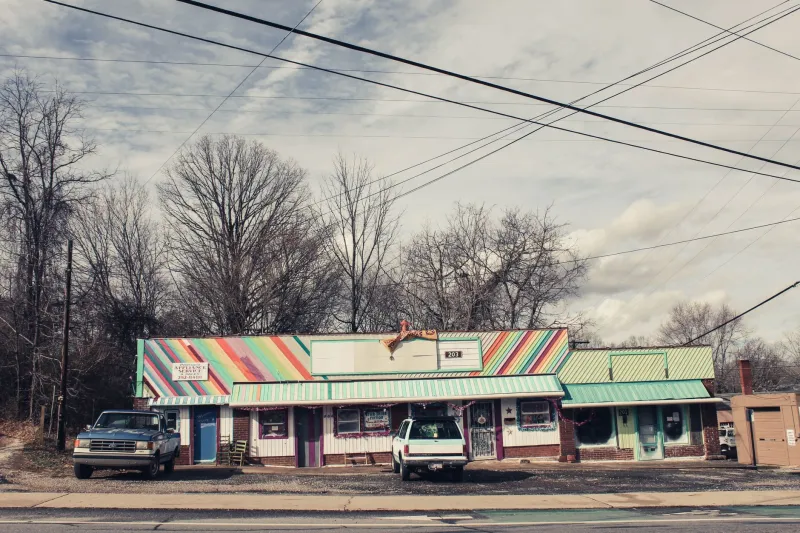
In early October I opened Google Street View on a town I had no reason to open it on, spun the little yellow guy around until he landed in front of a hardware store with a hand-lettered sign, and thought: that's a painting. Then I thought something dumber and better: what if I mailed it to them?
That's how the Thirty Storefronts project started. Small Business Saturday lands on November 28 this year, and every fall I get the same itch — the one that says make something for the people who actually sweep the sidewalk, not for the feed. So I gave myself a rule set, a stack of tiny panels, and a self-imposed deadline of one storefront per day for thirty days.
The rules, which I invented and then obeyed
One shop per town. No chains, no franchises, no place I'd ever set foot inside. The only reference material allowed was Google Street View, which is to say: pixelated, sun-blasted, occasionally haunted by a passing truck. I had to choose the shop based on what the street showed me — an awning, a window display, a sandwich board, a dog tied to a parking meter.
Each painting would be three by four inches, gouache on cold-press paper, three colors plus one loud accent. And every single one got mailed to the real address in a stiff envelope with a short note: no invoice, no QR code, no ask.
Scrolling for awning energy
The scavenger hunt was the easy part and also the trap. I'd start in a town of eight thousand people in Ohio, follow the main drag to the edge, then jump somewhere else entirely — a bookstore in Maine with a blurry cat in the window, a taqueria in El Paso with a hand-painted sign in three shades of red, a barber shop in Kansas where the pole was the only color on the block.
Street View is the world's worst reference photo and the best excuse. You can't see the brickwork, so you invent it. You can't read the small print on the sign, so you commit to a shape and hope. By day ten I had a running note on my phone titled AWNING ENERGY, full of entries like mustard with brown stripes, faded teal, that green that only exists on 1970s storefronts.
Three colors and one small lie
Here's the honest part about painting from a screen: most of these shops are not as saturated as I painted them. I pushed the palette hard — a Kansas barber shop in coral and cream, a Maine bookstore in deep navy with a butter-yellow window. Nobody's storefront is that loud in real life. Mine are, because a three-inch painting needs to shout to be heard from across a room.
The other thing I learned: a storefront is mostly a face. Windows are eyes, the door is a mouth, the awning is a hat. Once you see it that way you can't unsee it, and it makes the painting decisions faster. Give the hardware store a stern hat. Give the bakery a friendly one.
The envelope part, which was genuinely terrifying
I bought rigid mailers in bulk, wrote thirty addresses by hand, and spent about $2.50 per package on postage. Then I stood in line at the post office holding a stack of tiny portraits of buildings that belonged to people who had no idea I existed.
The fear is specific and a little embarrassing. What if they think it's weird? What if it's the wrong address? What if the mailer bends and someone opens an envelope to find a sad, creased rectangle where a shop used to be?
I mailed them anyway, in batches of six, mostly so I'd stop rereading the notes.
What actually came back
More than I expected, and slower than I'm used to.
A hardware store owner in Ohio taped hers next to the register and sent a photo of it beside a wall of paint cans. A bookseller in Maine wrote that the cat in the painting was, quote, close enough, and that the real cat was offended. One barber propped his in the mirror so customers could see the back of their own head next to a tiny version of the building they were sitting in.
Two shops never replied. One envelope came back marked return to sender — the business had closed sometime between the street imagery and the mailing — and I have to tell you, that one hurt in a way I didn't plan for. I still don't know what to do with it. It's sitting on my desk.
And one owner wrote a full paragraph about how she'd been thinking about repainting her sign and now she wasn't sure, because the version on her wall was better. That's the one I keep thinking about.
The part where I stop checking analytics
I make a lot of work that gets measured. Impressions, saves, comments, the little graph that goes up or doesn't. It's not evil, it's just fast, and fast feedback makes you twitchy.
Mailing thirty paintings was the opposite of that. There's no notification. There's a gap of days, then a mailbox, then maybe silence. The feedback loop is so slow it forces you to decide what you actually think of the work before anyone else weighs in. I liked all thirty. I liked them more after I couldn't take them back.
What I'd change next time
Paint in a warmer month so the mailers don't sit in a cold truck. Call ahead for at least the ones that look shuttered. Use colored envelopes instead of plain brown, because a brown envelope looks like a bill and a red one looks like a present.
And I'd do it again, which is the real review. Thirty tiny buildings, thirty stamps, thirty front doors I've never walked through. Small Business Saturday is November 28 — go buy something from a shop with a good hat. If there's a small painting on the wall behind the register, say hi to it for me.